A house of mud

By the sea

Using candles

Inhabited by people who sleep very little.


A house of paper

On open ground

Using all available lighting Inhabited by very tall people.


A house of dust

On open ground

Lit by natural light

Inhabited by friends and enemies.

—“House of Dust (1967)” generator coded by Nick Montfort from Memory Slam 2.0: Batch Era Text Generators
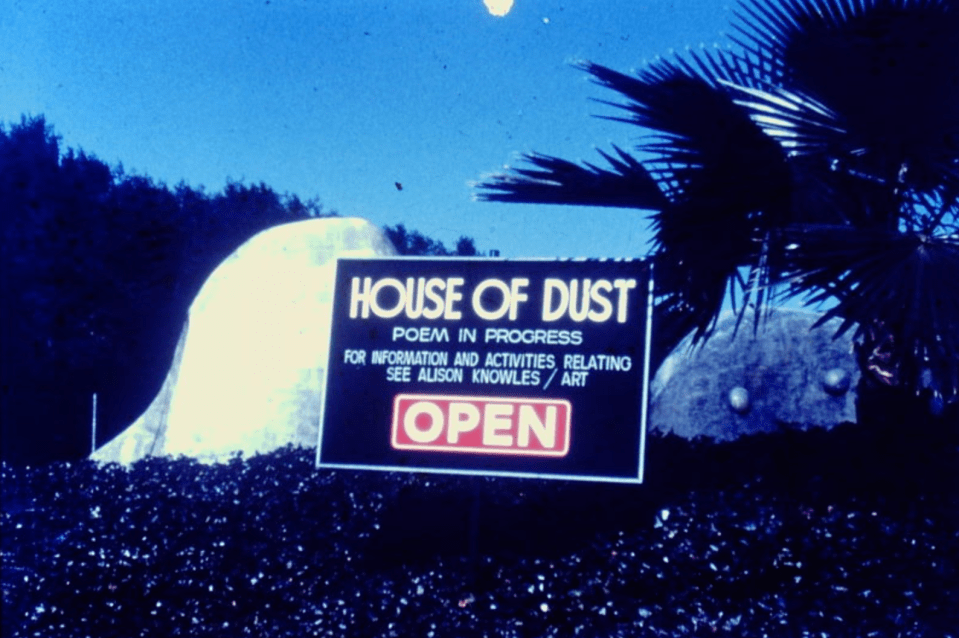
From 1970-1972, Los Angeles county hosted the House of Dust, an intermedia built space whose blueprint was co-imagined by Fluxus artist Alison Knowles and a Siemens 4004*. The project had begun as a computerized poem listing houses of varying materials, light sources, contextual situations, and groups of inhabitants. The following year she began constructing houses from the poem in New York and California.
At a time when storytellers and the makers of cultural narratives expressed fear at the growing influence of the “mechanical brain,” marking what seemed to be the end of creativity, Knowles sought out specifically to leverage a computer’s surrealistic capabilities, its aptitude for generating scenarios outside of established logic, in a sort of cyborg exquisite corpse.
“House of Dust” took the foundational cultural construct of a home and, by running it through a fixed algorithm, found moments of unexpectedness that displaced a familiar concept with something surprising and surreal. She then began generating these homes in the real world, ending with “House of Dust.” Fifty years and several generations later (in both human and computer terms), this process is still a useful one for navigating human-technological relations in a way that is just weird enough to suspend our more immediate reactions so we can sit with the nuanced tentacles branching out from this technocultural moment into many potential future realities.
In “Cyborg Surrealism: The Reading Room,” we as ethnographers have an opportunity to revisit the foundational cultural constructs of archive, documentation, and the mundanely holy academic article and, by running it through a vector database, mine moments of unexpectedness to displace that familiar concept with something surprising and surreal. This project has roots in the EPIC 2022 “Post-Apocalytic Cocktail Hour,” which featured a “poster session” populated by posters of speculative academic research; using a mixture of generative AI tools, these and other hypothetical sites of research and future communities of practices can be developed, explored, and generated into small-run academic magazines, a different type of house for the EPIC community. Where this proposal departs from Knowles’s original vision, it is in tone, and that is by intention. Where the staid voice and big-enough-to-fill-a-room formality of midcentury computing suited “House of Dust,” a stronger spirit of parody is intended here, to appropriately match the structural Weird-Al-Yankovic-ness of what an LLM or diffusion model inherently is.
To that end, this project aims to provide EPIC 2024 attendees with a cozy reading nook (can be indoors or outdoors) containing seating and a display bookcase containing between one and two dozen speculative academic journals, with several copies for each. A table in the center of the reading area serves as a sort of grounding rod: it contains a basket of contextualizing questions that root the speculative experience with an invitation to consider the material and embodied second- and third-order effects of the realities reflected in and by these journals; next to the basket, a 1993 Tiger Electronics Talkboy tape recorder and a stack of cassettes, inviting participants to leave comments, insights, questions, etc., in a format that underscores the rate of technological change embodied in memory within a single human generation—and with it, a way to recalibrate the speculative distance between the alternate futures embodied by the journals and the conference participants encountering them in 2024.
*The Siemens 4004 was no stranger to creative collaboration, and famously cameoed in the 1971 film Willy Wonka and the Chocolate Factory.
 Cyborg Reading Room